Among the sub-agendas on which the Ethiopian National Dialogue Commission is engaging around 4,000 participants, “Issues of Political Representation and Electoral System” under Agenda Number Two is a primary focus. Ethiopia currently uses the First-Past-the-Post (FPTP) plurality system, while Proportional Representation (PR) has been presented as an alternative for discussion. The central question of the dialogue is: “Which system allows diverse political viewpoints and segments of society to have fair representation?”
To answer this question, “Ethiopia Insider” conducted an in-depth analysis of the 7th General Election figures, examining what difference it would have made if the votes cast under the plurality system had been calculated using a proportional representation system. Furthermore, it compared the strengths and weaknesses of both systems by reviewing various research studies.
The plurality system currently in place in Ethiopia makes only the candidate who secures the most votes in a given constituency the winner. References, including the Encyclopedia Britannica, describe this system as a “winner-takes-all” approach. In contrast, a proportional representation system ensures that the distribution of parliamentary seats corresponds proportionally to the overall share of votes cast by the electorate. Accordingly, if a political party wins 40 percent of the popular vote, its parliamentary share under a pure proportional representation system would likewise be 40 percent of the seats.
The plurality system is practiced in the United Kingdom, Canada, and India, whereas most Scandinavian countries, including the Netherlands and Sweden, utilize proportional representation.
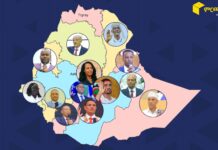
Based on this premise, “Ethiopia Insider” recalculated the results of the 7th General Election. The analysis confirmed that, out of the 486 declared House of Peoples’ Representatives seats, 15 seats that could have been won by opposition representatives went to the ruling Prosperity Party under the plurality system if regional votes had been allocated according to the parties’ percentage shares.
Particularly in Addis Ababa, where nearly 40 percent of voters cast their ballots for opposition parties or independent candidates, the ruling Prosperity Party won 20 of the 23 parliamentary seats under the current FPTP system. The numbers indicate that, under proportional representation, it would have won only 14 seats.
As the graphic shows, because the electoral system is plurality-based, the Prosperity Party gained seats beyond its proportional share of votes: 6 in Addis Ababa, 3 in South Ethiopia, 2 each in Amhara and South West Ethiopia, and 1 each in Benishangul-Gumuz and Gambella regions.
Conversely, in Afar, Dire Dawa, Harari, and Oromia—where the ruling party secured over 90 percent of the vote—as well as in Central Ethiopia (84%), Sidama (81%), and Somali (85%) regions, where it received over 80 percent, calculating the results under proportional representation would not yield any notable change compared to the current outcome.
According to the calculations by “Ethiopia Insider” on which opposition parties would have benefited under proportional representation based on the popular vote, the Coalition for Peace in Ethiopia could have gained 2 additional seats, while the Freedom and Equality Party (FEP) and the Coalition for Ethiopian Unity could have each secured 2 additional parliamentary seats.
In total, 14 parties could have gained greater representation than the seats they secured under the current system, whereas 5 parties, including the Prosperity Party, would have seen a reduction in their current seat tally.
Which System Is Viable for Ethiopia?
In its handbook titled Electoral System Design, the International Institute for Democracy and Electoral Assistance (International IDEA) sets out the fundamental principle that “there is no single electoral system that fits all countries.” However, it advises that multinational, deeply divided, or post-conflict nations would benefit from adopting proportional representation or a mixed system combining both.
It explains that in conflict-affected societies, a “winner-takes-all” zero-sum system can reignite grievances and disputes, making the inclusiveness of proportional representation vital so that all stakeholders have parliamentary representation.
On the other hand, if a country’s society is culturally homogeneous and enjoys a stable political climate, the plurality system facilitates direct accountability between voters and their local representatives and allows stable governments to form more easily.
For nations seeking both geographical representation and electoral fairness, International IDEA points to mixed systems as viable alternatives, such as those seen in Germany and New Zealand. International IDEA recommends that diverse developing nations, such as those in Africa, lean toward proportional or mixed systems, as the plurality system tends to entrench authoritarianism and absolute single-party dominance.
Other political scientists share recommendations similar to International IDEA’s. In his renowned book Patterns of Democracy, Dutch-American scholar Arend Lijphart, Professor Emeritus of Political Science at the University of California, argues that proportional representation offers superior democratic quality and fairness compared to the plurality system by including minorities, increasing women’s representation, and allowing diverse voices to be heard.
Similarly, Harvard University Professor Pippa Norris, in her book Electoral Engineering, explains that if the goal is “representation, inclusiveness, and fairness,” proportional representation is preferable; but if the goal is “creating a strong and accountable government quickly,” the plurality system is chosen.
While proportional representation is criticized for operational complexity and occasionally causing government instability, the plurality system’s primary shortcoming is that it wastes millions of voters’ ballots.
It is worth recalling that at the beginning of 2010 E.C. (late 2017 / early 2018 G.C.), 16 political parties in Ethiopia, including the ruling EPRDF, agreed during “negotiations” on a mixed electoral law allocating 80 percent through plurality and 20 percent through proportional representation. However, a change of government occurred before a full agreement on other related issues could be reached and before the legislation was amended. (Ethiopia Insider)